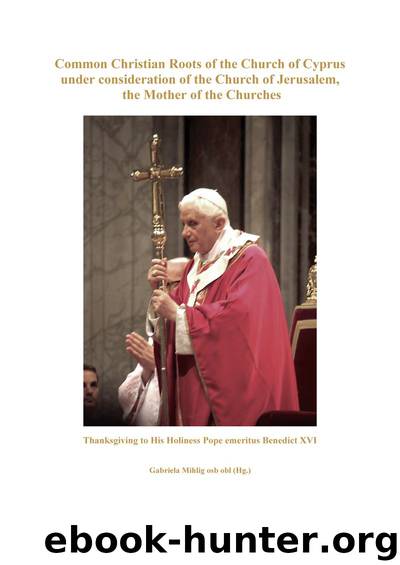
Common Christian Roots of the Church of Cyprus under consideration of the Church of Jerusalem, the Mother of the Churches by Gabriela Mihlig
Author:Gabriela Mihlig
Language: deu
Format: epub
Publisher: Stockers
Published: 2014-11-15T00:00:00+00:00
© GM
3.2 Liturgy
(Source: Maronite Patriarchal Synod, text 12: the Liturgy)
Introduction
The liturgy is the living treasure of the Maronite Church. It is on a permanent pilgrimage toward the Kingdom of the Father. The Church is enriched by the liturgy; in fact, her spiritual and human experiences become richer through it. The liturgy plays a central role on the journey of the Church. It is one of the most essential constitutive elements of the Church that begins with the Paschal Event: the death of the Lord Jesus on the Cross and his Resurrection from the dead. The liturgy is the source from which the Church draws her spirituality and puts on holiness. It is the goal of all ecclesial activities dealing with the mysteries and the missionary efforts of the Church’s presence in the world.
The liturgy was the primary subject that ecumenical councils dealt with. To show how important the liturgy is to the life of the Church, the fathers of Vatican II chose to treat it in a special constitution in the first session. The Maronite Church accorded great importance to the liturgy from the 16 th century to the middle of the 20 th century in her local synods. This attention given to the liturgy helped her easily implement the instructions of the Vatican Council and answer the repeated calls of the popes and, more recently, the apostolic exhortation "A New Hope for Lebanon." In responding to these calls, the Maronite Church renewed the structures and texts of her rituals according to the instructions laid down in “The Constitution on the Liturgy” by returning to the sources 2 and origins. This Synodal journey offers a fitting occasion for this renewal.
The liturgical experience of the Church flows out of the Holy Trinity and returns to it. The liturgy is the expression of the Church’s prayerful experience with and toward the Trinity. Through it, the redeemed community thanks and glorifies God the Father, Creator and Savior. Her expression of gratitude is a Eucharist offered with the Only Son who thanked the Father for the salvation realized in him for the sake of the world. The liturgy of the Church is achieved by the Holy Spirit who came down upon it at Pentecost and who dwells within it during the liturgical celebration. The Holy Spirit completes seals and realizes in it and in the world the fruit of salvation. The Spirit is the one who guides the Church of Christ. The Spirit leads her, renews her and makes her a permanent Pentecost; he prays in her with patience beyond description. Therefore, the liturgy is the work and the celebration of the Holy Trinity; it flows from and returns to the Holy Trinity. Through this Trinitarian dynamism the Church becomes one with the paschal mystery of Christ’s death, descent to Sheol, and resurrection. Thus, the liturgical celebration becomes a living experience of a renewed Easter and a continuous proclamation of the resurrection 3.
The liturgy occupies the most central place in the Church. It is one of the constitutive elements of the Church.
Download
This site does not store any files on its server. We only index and link to content provided by other sites. Please contact the content providers to delete copyright contents if any and email us, we'll remove relevant links or contents immediately.
The Secret Power of Speaking God's Word by Joyce Meyer(3159)
Signature in the Cell: DNA and the Evidence for Intelligent Design by Stephen C. Meyer(3123)
Real Sex by Lauren F. Winner(3005)
The Holy Spirit by Billy Graham(2938)
The Gnostic Gospels by Pagels Elaine(2517)
Jesus by Paul Johnson(2349)
Devil, The by Almond Philip C(2323)
23:27 by H. L. Roberts(2245)
The Nativity by Geza Vermes(2222)
Chosen by God by R. C. Sproul(2158)
All Things New by John Eldredge(2151)
Angels of God: The Bible, the Church and the Heavenly Hosts by Mike Aquilina(1951)
The Return of the Gods by Erich von Daniken(1925)
Angels by Billy Graham(1917)
Knowing God by J.I. Packer(1848)
Jesus of Nazareth by Joseph Ratzinger(1802)
The Gnostic Gospel of St. Thomas by Tau Malachi(1781)
How To Be Born Again by Billy Graham(1775)
Evidence of the Afterlife by Jeffrey Long(1773)
